Machine Basics
$2,999.00
- FibreSeeker 3
- 1 × X-CCF carbon-fiber roll, 500 m
- 1 × X-CGF glass-fiber roll, 500 m
- 2 × PETG rolls


Desktop continuous carbon and glass fiber reinforcement
Choose a kit
In stock · Ships in 3–11 business days
Frequently bought together
Swipe for more
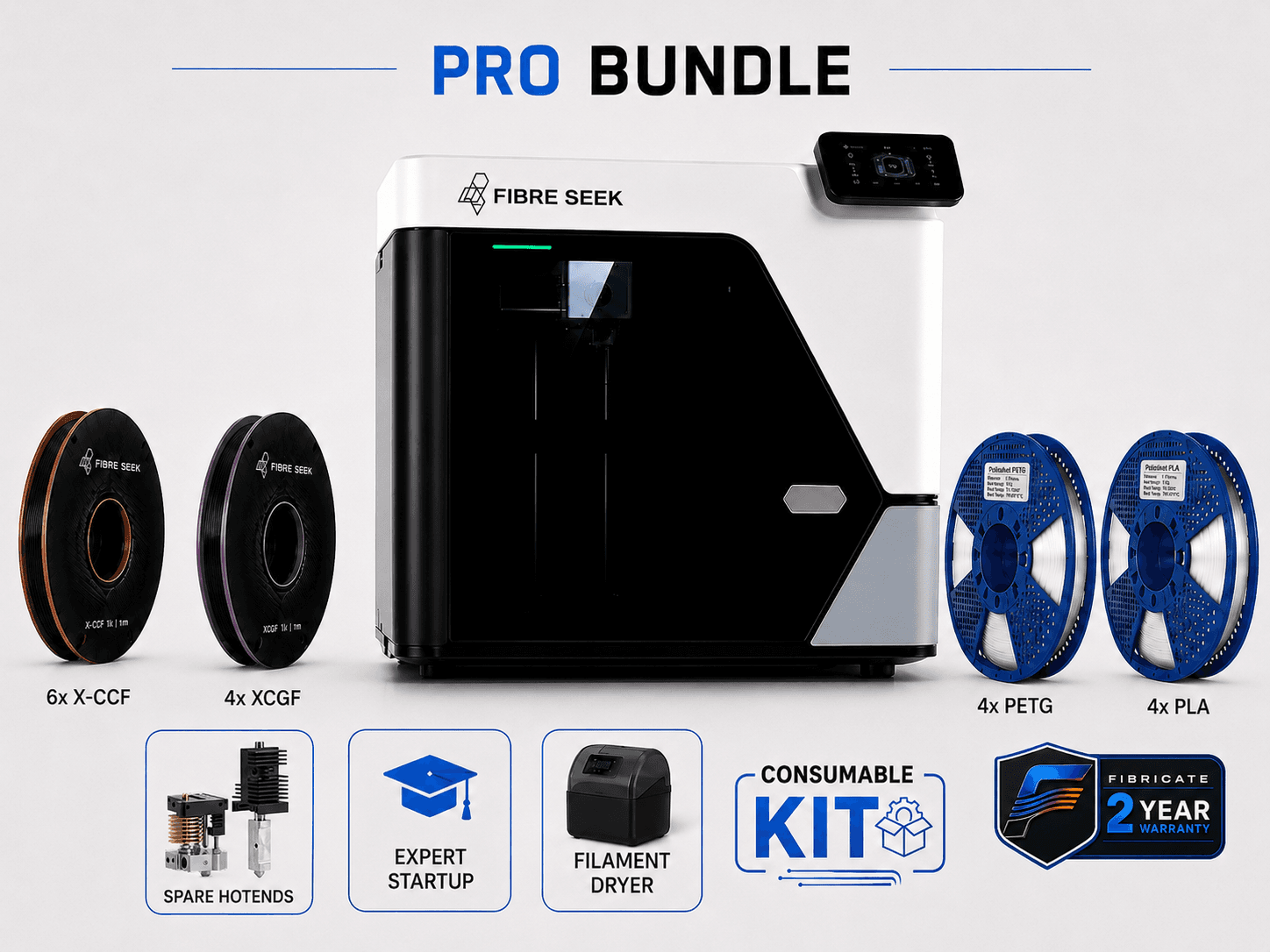
Every kit ships the same FibreSeeker 3. What changes is onboarding, spares, warranty, and how much fiber you start with. Compare all four kits.
$2,999.00
$3,745.00
$4,795.00
$5,795.00
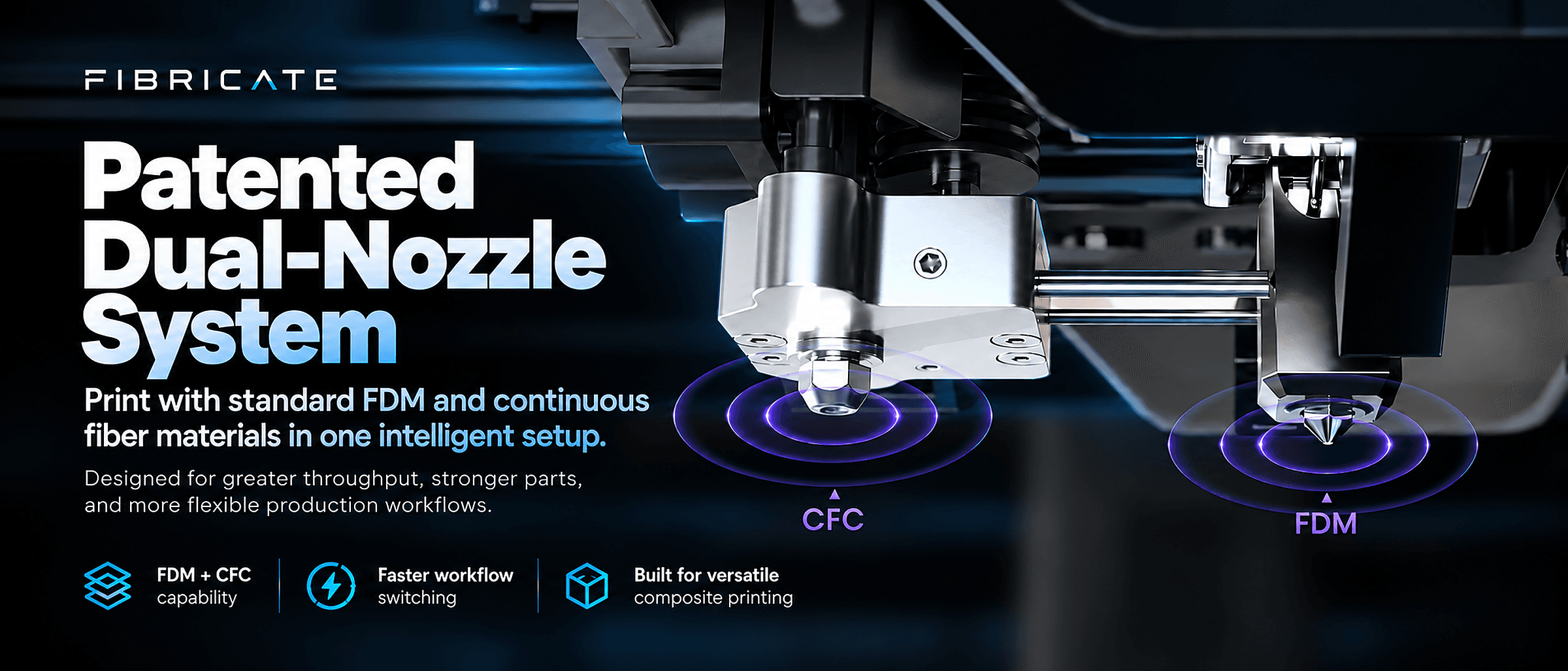
The FibreSeeker 3 uses dual extrusion: Fused Filament Fabrication (FFF) for thermoplastic and Composite Fiber Co-extrusion (CFC) for continuous carbon or glass fiber. Full-length fiber strands are embedded in the plastic matrix during printing so fiber orientation follows the load path — not random short fibers inside a spool. The result is structural composite parts at a desktop footprint and a fraction of the cost of CNC machining or traditional composite layup.
Switch modes per print depending on whether you need speed, strength, or peak structural performance.
Specifications are summarized for buyers on fibricate.com. Always verify the latest datasheet for your material system before committing production parameters.
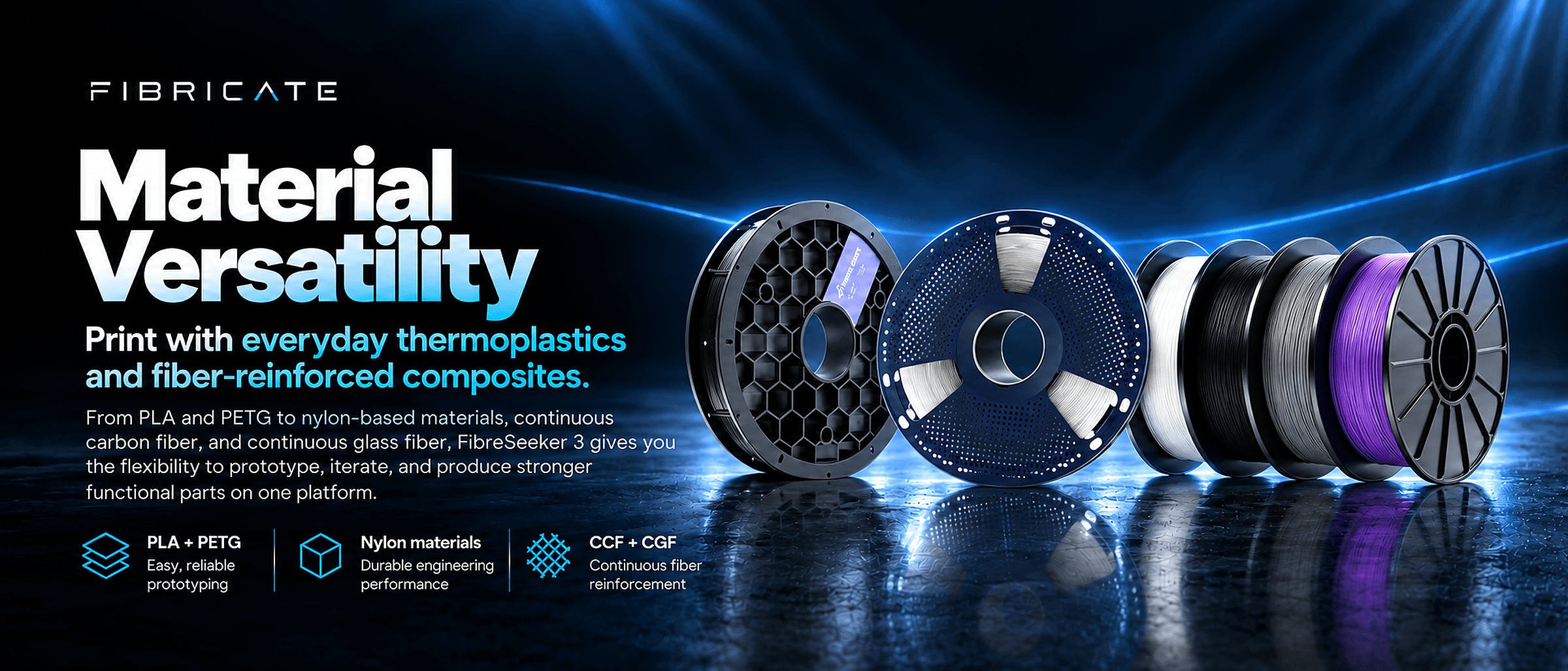
The FibreSeeker 3 supports these FFF plastics (1.75 mm filament).
Co-extruded via the CFC nozzle to embed full-length fiber strands into the thermoplastic matrix.
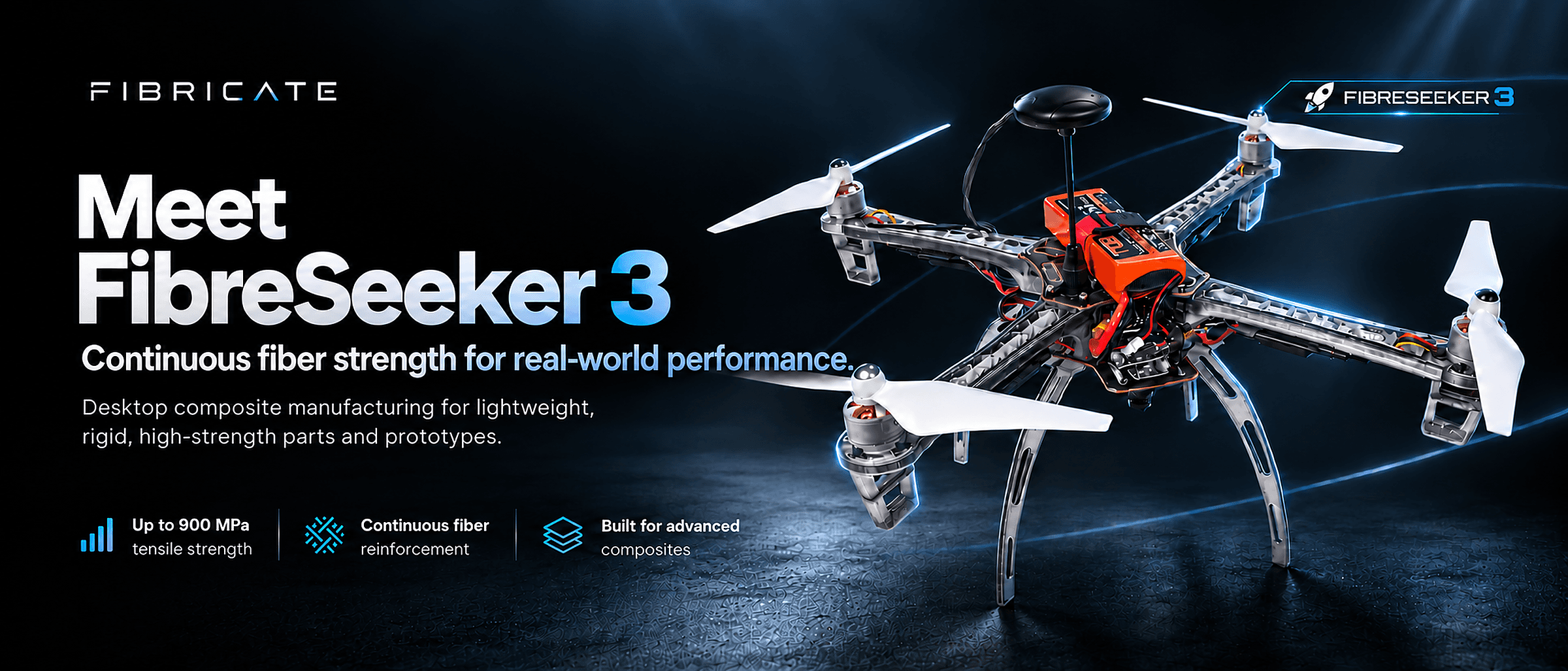
Continuous fiber 3D printing embeds full-length reinforcement strands — carbon fiber or glass fiber — directly into a thermoplastic matrix as the part is printed. The FibreSeeker 3 uses Composite Fiber Co-extrusion (CFC) for fiber and Fused Filament Fabrication (FFF) for plastic: a dual-extruder system where one nozzle handles thermoplastic and a second nozzle co-extrudes continuous fiber and polymer together. This places fiber exactly where load demands it, layer by layer, unlike chopped-fiber filaments or standard FDM which offer no directional reinforcement.
In Hyper Strength Mode (CFC nozzle only), composite parts can reach tensile strength up to 900 MPa — more than twice the tensile strength of 6061 aluminum, at a fraction of the weight. Strength varies by material system, geometry, and fiber path, so always verify your specific material datasheet for production parameters.
High Speed Mode uses the FFF nozzle only for standard thermoplastic printing at up to 500 mm/s — best for rapid prototypes and non-structural parts. High Strength Mode runs both the CFC and FFF nozzles simultaneously, adding a continuous-fiber skeleton to plastic parts with an adjustable fiber ratio. Hyper Strength Mode runs the CFC nozzle alone for maximum structural performance, achieving up to 900 MPa tensile strength. Max CFC throughput is 20 cc/h.
Mark Two: 5.3× more. X7: 22× more.
See the full comparisonFFF plastics: PLA, PETG, PC, PA, PACF, and PETGF (1.75 mm filament). CFC reinforcement fiber: X-CCF (continuous carbon fiber) and X-CGF (continuous glass fiber). Composite tensile strength is up to 900 MPa depending on material system and geometry.
Yes, for many engineering applications. Continuous carbon fiber composite parts from the FibreSeeker 3 can match or exceed the strength-to-weight ratio of aluminum components — without setup fees, molds, or minimum order quantities. Common metal-replacement use cases include UAV frames, robotic joints, structural brackets, jigs and fixtures, and bike components.
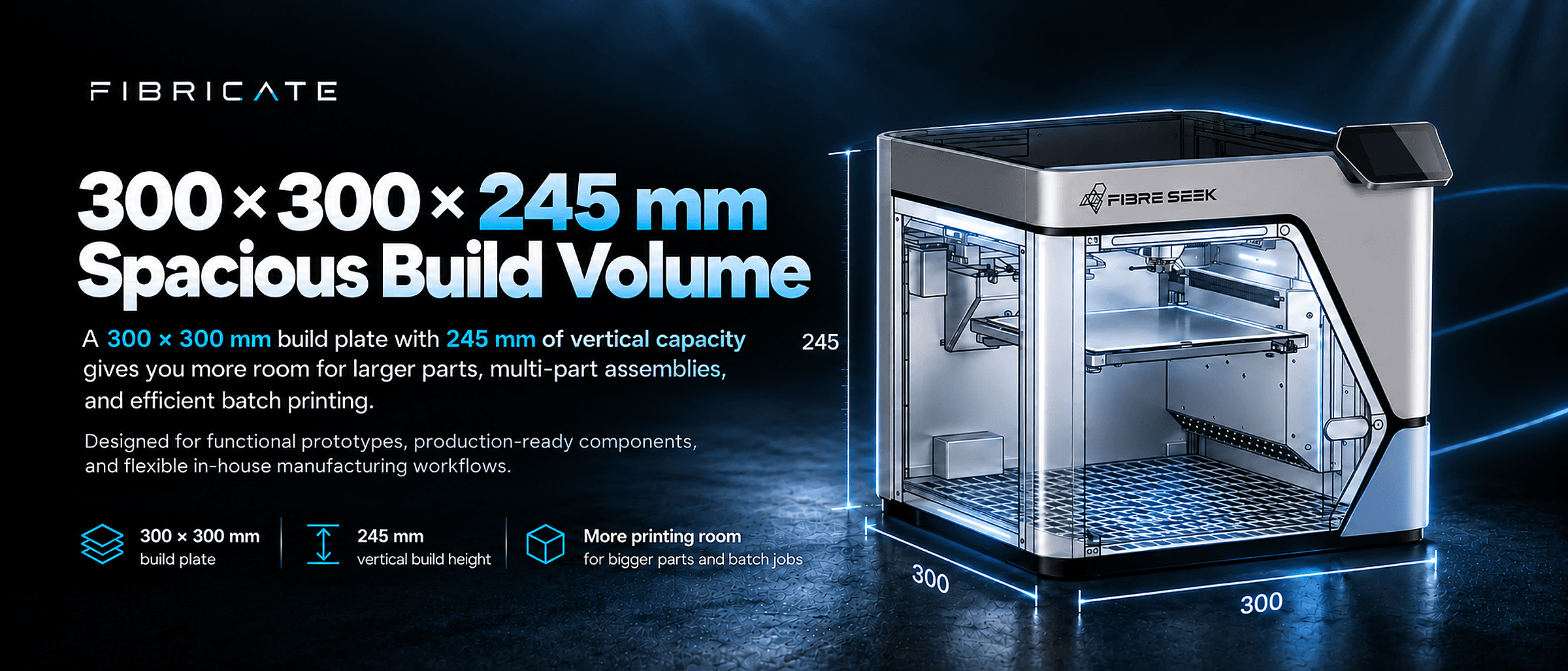
Build volume is 300 × 300 × 245 mm (11.81 × 11.81 × 9.65 in). Max FFF speed is 500 mm/s; max CFC speed is 20 cc/h. Printing accuracy is ±0.2 mm, with a minimum layer thickness of 50 μm.
Device dimensions are 615 × 595 × 540 mm. Device weight is 32 kg. The outer frame is plastic and glass.
All-metal hotend with hardened steel nozzles. FFF nozzle diameter is 0.4 mm; CFC nozzle diameter is 0.7 mm. Max FFF and CFC nozzle temperature is 350°C. FFF filament diameter is 1.75 mm. A built-in fibre cutter is included.
Active chamber heating is supported (max 65°C). The build plate is a flexible high-temperature base; max heatbed temperature is 110°C with fully automatic bed leveling. FFF plastic feeds from back hangers; CFC fibre is stored in an embedded chamber.
Part cooling, hotend cooling, and main control board fans all use closed-loop control. Sensors include a built-in live view camera (1280×720), plastic breakage detection, fiber breakage detection, and fiber clogging detection.
Voltage: 100–120 VAC / 200–240 VAC, 50/60 Hz. Maximum power: 1350 W.
A 5-inch touchscreen for on-machine control, plus PC app control. Built-in 32 GB eMMC storage and a USB port.
Rocketslicer (FFF+CFC) on Windows and Mac. Compatible data formats are STL, STP, and 3MF. The slicer analyzes load distribution and fiber path to generate optimized toolpaths for continuous fiber printing.
Yes. Fibricate is the authorized US reseller for the FibreSeeker 3. The printer is sold as Machine Basics at $2,999, which includes starter carbon fiber, glass fiber, and two PETG rolls. Flat-rate shipping ($200) is added at checkout. Orders ship from the USA in USD. In-stock orders typically ship in 3–11 business days.
The standard warranty is twelve (12) months for the complete machine and six (6) months for the hotend, excluding consumables and wear items (including nozzles, build sheets, belts, fans, filaments, adhesives, filters, and other items the manufacturer identifies as consumable or wear). During the warranty period, the manufacturer may repair or replace defective parts or provide an equivalent remedy if a covered defect is confirmed. Fibricate, as the authorized US reseller, coordinates warranty claims and support for US customers.
Remote diagnostics and troubleshooting are included, with step-by-step guidance and video support available.
Continuous fiber printing is ideal anywhere lightweight, high-strength, or fatigue-resistant parts are needed. Primary industries include aerospace and UAV (drone frames, structural airframe components), robotics (joints, end-effectors, arms), industrial manufacturing (jigs, fixtures, production tooling), automotive (custom brackets, lightweight components), and medical (prosthetics, orthotics). It is also widely used for engineering research and education where metal-grade performance at prototype volumes would otherwise require expensive CNC machining.
The FibreSeeker 3 is designed to be accessible whether you are a home maker, workshop builder, or startup engineer. Fully automatic bed leveling handles setup, and the 5-inch touchscreen makes day-to-day operation straightforward. Rocketslicer guides fiber path decisions so you do not need a composites engineering background to get strong, reliable results from the first print.